

Sutherland was the first place where I really understood how hard it is to market a large technology company well. There were strong products, smart SMEs and plenty of customer proof, but the story was not always easy to follow from the outside. Different teams used different language, case studies lived in different places, and the value of an offering could get buried under technical detail.
My role was to make that complexity easier to understand and easier to use. I joined as a Senior Content Marketer and was later promoted to Senior Manager, Corporate Marketing, working across Cloud, Digital Engineering, financial services and healthcare. I helped shape product positioning, campaign content, customer stories, executive thought leadership and web messaging, with one goal in mind: make the company clearer to the people we wanted to reach.
Who I was writing for
Most of the people we were trying to reach were senior decision-makers: CIOs, technology leaders, banking executives and healthcare leaders evaluating cloud, automation and digital engineering programs with real cost, risk and internal scrutiny attached to them.
So every piece had to earn its place. The message had to be clear on what the solution did, where it fit, what business problem it solved and what proof we had that it worked. That became the bar for the content I worked on.
Where things stood
The Suneratech acquisition made the positioning problem much bigger. Sutherland now had 40+ products and services that needed to be explained more clearly, and the existing language did not always make the differences or the value obvious to a buyer.
There was also a library of about 110 older customer case studies that needed work. Many focused on what had been delivered rather than what had changed for the customer. At the same time, demand generation needed campaign content across different markets, Sales needed stronger proof, and executives needed a clearer voice. The work was really about bringing those pieces into one coherent story.
What I did
i. Clearer positioning for 40 products and services.
I worked directly with SMEs and business leaders to understand each offering before rewriting it. I wanted to know who it was really for, what problem it solved, what changed for the customer, and why someone would choose it over another option.
Each page then had to work on two levels: explain the value clearly and compete in search. I mapped the copy to search intent, reviewed the SERP, assigned a primary keyword target, tightened headings and metadata, improved internal linking, and structured key sections so they were easy for both search engines and AI tools to understand and cite. The result was a much more consistent website, with clearer positioning across 40+ offerings and a stronger foundation for SEO, SERP visibility and emerging AI search.

ii. The case study library.
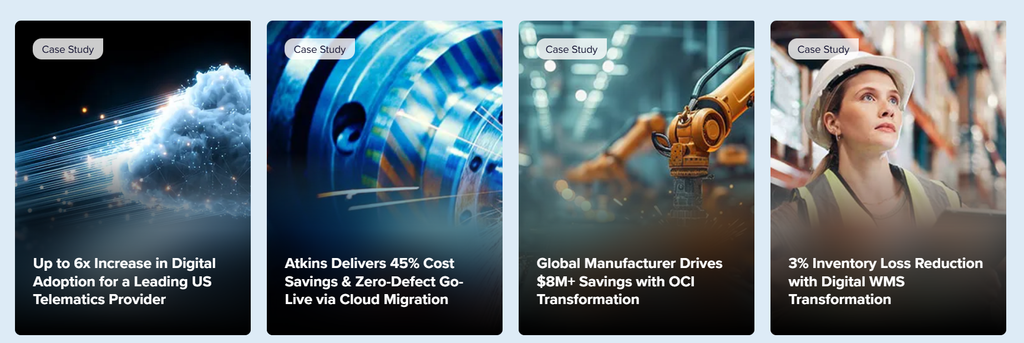
I went through more than 110 case studies and rebuilt them around the result. The key questions were simple: what became faster, what cost less, what risk went away, and what could the customer do afterwards that they could not do before?
That shift made the stories much more useful for Sales and demand generation because the proof was easier to find and easier to reuse. I also mapped each case study by industry, business problem, solution and measurable outcome, so a salesperson could quickly find the closest customer proof for the account they were working on.
Content that had a job beyond getting published.
For Cloud and Digital Engineering campaigns, I worked across whitepapers, eBooks, landing pages, case studies, product videos, web copy and sales enablement. Each asset had a clear role in the buyer journey.
A long-form piece could introduce the problem. A landing page captured intent. A customer story added proof later in the conversation. Product videos gave Sales an easy way to open the door, then had a second life as ad creative. Across those businesses, content eventually influenced 26% of pipeline.
An executive voice that sounded less corporate.
I worked closely with the CEO and other C-suite leaders to turn their ideas into thought leadership. A lot of the work started with a 30-minute conversation. I would interview them, pull out the strongest point of view, and then shape that into a LinkedIn post, a longer blog, a guest article, a presentation, or talking points they could use elsewhere.
Sometimes one conversation would become several things. A leadership idea could turn into a post, then a thought-leadership article, then a presentation, and later help shape podcast or media requests. The goal was to make their expertise travel further without flattening their voice into corporate language. Once the approach started working, we expanded it across senior leadership, and executive engagement increased 142% in three months.
What changed
The number I care most about from that period is the 26% of pipeline influenced by content across Cloud and Digital Engineering Services.
But the broader picture matters too. Selected campaigns generated 1500+ downloads, 400+ leads, 250+ demos. 40 products and services had clearer positioning. 110 customer stories had been rebuilt around business outcomes. Executive engagement increased 142% in three months. And during that time, I moved from Senior Content Marketer into a Senior Manager role.
More than anything, Sutherland changed how I work on complex B2B content. I learned that the useful part usually happens before the writing starts. You have to stay with the SME long enough to understand what they really mean, ask the questions they assume everyone already knows the answer to, and then figure out which part of that matters to the buyer.
Once that is clear, the writing gets much easier.
What I’d do differently
I’d bring Sales into the content process earlier.
I worked with Sales and demand generation, but today I would make recurring Sales conversations part of the editorial process from the start. They hear the objections, questions and buying signals first, which makes them one of the best sources of content ideas inside the company.
I’d measure content closer to revenue.
We could see pipeline influence and campaign performance, but I would want a cleaner view of how specific topics and assets contributed to opportunity progression and closed business. That would make it easier to decide what deserved more investment and what did not.
Sutherland taught me that strong enterprise content should reduce friction. It should help a buyer understand the problem faster, give Sales better proof, and make the next step feel easier. That is the standard I still use now.



Leave a Reply